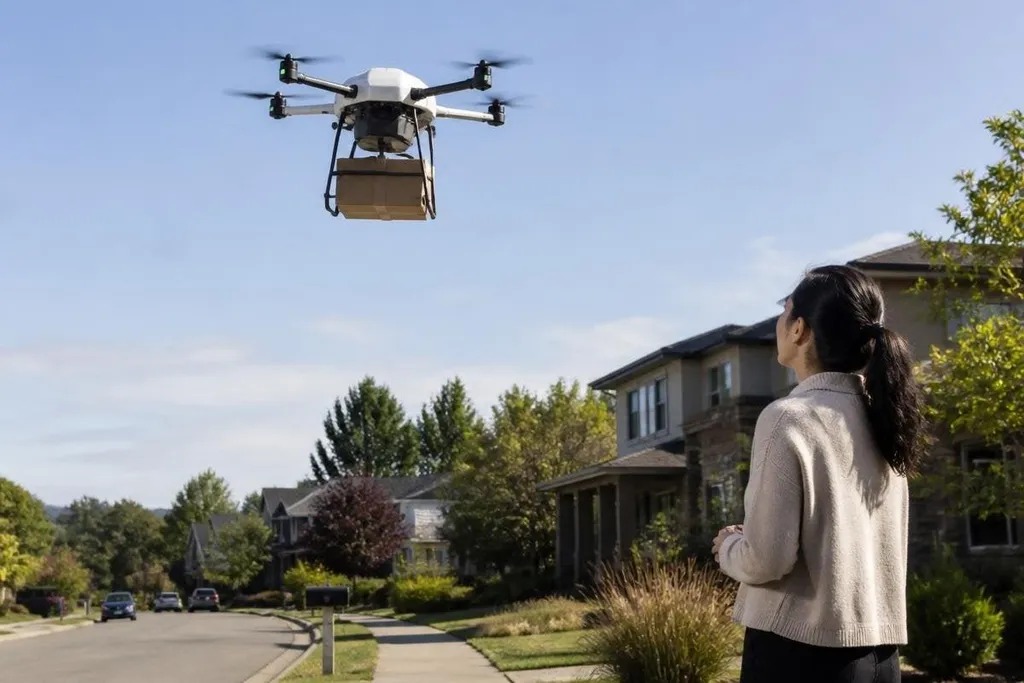
A delivery drone can move an online order from a local dispatch point to a customer without using a road for the whole trip. That changes the final part of delivery, where traffic, distance, and the cost of sending a driver often matter most.
- Drones carry small orders from a nearby site to a marked landing area.
- GPS, cameras, and onboard software guide the flight and check the route.
- Weather, battery range, air rules, and handoff safety still limit where drones work.
What the drone changes
A normal parcel route depends on roads and a delivery vehicle. A drone flies directly between approved points, so a short road trip can become a short air route when the local rules and terrain allow it.
That works best for light goods that customers want soon. A pharmacy order, grocery item, or small electronics package may fit the aircraft. A large box, several heavy items, or an order that needs a signature still needs another delivery method.
The order also needs a suitable place to land or lower the package. A backyard, open driveway, or prepared pad may work. A crowded street, tall fence, or narrow apartment courtyard creates a harder handoff, even when the flight itself is safe.
How the flight works
The process starts before the aircraft leaves the dispatch site. The delivery system checks the order weight, battery charge, route, airspace limits, and drop location. A geofence then marks areas the drone must avoid, such as restricted airspace or a nearby airport.
During flight, the drone uses satellite positioning and onboard sensors to hold its route. Cameras can help it read the landing area, while other sensors detect objects near the aircraft. A remote operator may watch the flight or step in when the system finds a problem.
The package handoff needs its own safety check. Some designs land and release the order. Others lower it on a line while the drone stays above the ground. The second method can help where a landing spot is too small, but it adds another moving part to the delivery.
A drone can finish its flight and still leave the retailer with an unproven delivery service. Delivery drone reporting from Robot24.com can tie each claim to the route, handoff method, test date, and order result. Those facts set up the limits that appear once weather, airspace, customer access, and battery reserve enter the job.
Where the limits show up
Battery range sets a hard boundary. The drone must have enough power to leave the dispatch site, reach the customer, complete the handoff, and return or reach its next approved point. Wind, cold, rain, and extra payload can change that calculation.
Air rules shape the service too. A company may need approval for the route, limits on where the drone can fly, and a plan for remote supervision. Those rules differ by country and can change the number of customers one site can serve.
Noise and privacy also affect acceptance. A camera used to check a landing area may record nearby homes or people. A drone that passes over a quiet neighborhood may produce less traffic on the road, but it still adds aircraft overhead.
The largest unknown is the full cost per order. The aircraft is only one part of the system.
Staff, charging equipment, software, repairs, insurance, air approvals, and failed deliveries all count. A fast flight can still make poor business sense if the support work costs too much.
A buying and rollout checklist
If you run an online store or delivery service, check these points before adding drones:
- Order size: Set a clear weight and package-size limit that matches the aircraft.
- Drop sites: Map safe landing areas or line-release points at customer addresses.
- Weather rules: Record when wind, rain, heat, or cold will stop flights.
- Human control: Set out when a remote operator must take over.
- Return plan: Decide where the drone goes if the customer is absent or the site is blocked.
- Full cost: Count aircraft, staff, charging, repairs, insurance, and missed handoffs.
Start with routes that have a known dispatch point and repeatable drop locations. That gives the operator a clear way to compare drone delivery with vans, bikes, or pickup lockers.
I'd use drones for small, time-sensitive orders on short routes, and keep regular road delivery for large or uncertain drops. The next useful proof will be a full cost report covering failed handoffs, weather stops, and battery changes, not another short flight video.